Sighting the new moon
People await the verdict
Does Eid start tomorrow?
Tuesday, 30 September 2008


Saturday, 20 September 2008
North Qatar excursion
Yesterday I took a road trip to the north of Qatar, just to get out and have a look around. In honesty, I was doing a dive site reconnaissance mission, to see if there would be somewhere else worth going. There are coral beds on the north coast, but the problem is there is no gradual dropoff to constitute depth of any kind. Almost all the diving is boat-based here, unless you go to one of the man-made reefs (which we have been doing almost every weekend, but a change of scenery is always good...).
There aren't a lot of countries out there where you can go from one end to the other in less than half a day, but that's the case in 'the country which begins with Q'. In one hour's time, I made it from Doha, via the North Road, all the way up north-- a sleepy village called Madinat al Shamal, which is next to another sleepy village called Al Ruwais. At least half the population of Qatar lives in, or directly around, Doha. (Even if you go south, the road is still called the North Road-- so, no, I didn't made a ridiculous comment there by stating I went north on the North Road)
I found out that, other than a few more trees/ green outcroppings and a lot more rocks, North Qatar looks pretty much like the rest of the country.

There were more plant life outcroppings up north.
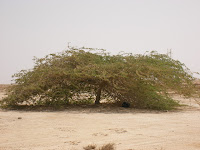
A Sidra tree. Sidra are known for their large branches, under which one can take shade in the desert. The logo of Qatar Foundation is a Sidra.

Stacked fish traps-- a common sight on coastal towns such as Madinat al Shamal.

Coast line, with blackened coral.

Submerged trees, looking toward Madinat al Shamal.
From Madinat al Shamal, I made my way west along the coast toward Al Zubara. There are a number of old forts and settlements along this part of Qatar. With my particular route, I came across one-- a small settlement called Algamel.

Abandoned Mosque.

Another view of the Mosque and manara (minaret). The manara is where the muezzin leads the call to Friday prayer and 5-times-daily prayer. Nowadays, the call to prayer usually comes over a loudspeaker (especially in shopping malls)/

Steps leading down from the top of the manara.

View from the top of the manara.

The stairwell to the manara was extremely narrow-- I had to sidestep.

The room just off the entrance, where people washed before entering the Mosque.
There aren't a lot of countries out there where you can go from one end to the other in less than half a day, but that's the case in 'the country which begins with Q'. In one hour's time, I made it from Doha, via the North Road, all the way up north-- a sleepy village called Madinat al Shamal, which is next to another sleepy village called Al Ruwais. At least half the population of Qatar lives in, or directly around, Doha. (Even if you go south, the road is still called the North Road-- so, no, I didn't made a ridiculous comment there by stating I went north on the North Road)
I found out that, other than a few more trees/ green outcroppings and a lot more rocks, North Qatar looks pretty much like the rest of the country.

There were more plant life outcroppings up north.

A Sidra tree. Sidra are known for their large branches, under which one can take shade in the desert. The logo of Qatar Foundation is a Sidra.

Stacked fish traps-- a common sight on coastal towns such as Madinat al Shamal.

Coast line, with blackened coral.

Submerged trees, looking toward Madinat al Shamal.
From Madinat al Shamal, I made my way west along the coast toward Al Zubara. There are a number of old forts and settlements along this part of Qatar. With my particular route, I came across one-- a small settlement called Algamel.

Abandoned Mosque.

Another view of the Mosque and manara (minaret). The manara is where the muezzin leads the call to Friday prayer and 5-times-daily prayer. Nowadays, the call to prayer usually comes over a loudspeaker (especially in shopping malls)/

Steps leading down from the top of the manara.

View from the top of the manara.

The stairwell to the manara was extremely narrow-- I had to sidestep.

The room just off the entrance, where people washed before entering the Mosque.
Tuesday, 16 September 2008
New Carnegie Mellon campus
I've been watching the building go up for the last year, so it will be exciting to go in and have a look.
A monumental campus in the making
Web posted at: 9/12/2008 3:43:11
Source ::: The Peninsula
A monumental campus in the making
Web posted at: 9/12/2008 3:43:11
Source ::: The Peninsula
 |
| The sunlight-flooded atrium. RIGHT: The external construction work of the building in progress. |
DOHA • The new campus of Carngie Mellon University in Qatar (CMUQ) will be an architectural wonder once complete, but even now the partially complete infrastructure is salubrious for its students and faculty.
"It is visually and functionally a spectacular building," said Charles E Chuck Thorpe, the Dean of the University, yesterday while speaking to the media during an orientation visit. "Structurally, the building has every thing that the university strives to create. The warm and inviting spaces throughout the building will foster the growth of the whole university," he told The Peninsula.
Flanked by Weill Cornell Medical College (WCMC) and Texas A&M University (TAMU) on both sides, the Carngie Mellon University in Qatar (CMUQ) is moving fast towards its official opening shortly.
The university had moved into its new building at the beginning of the new semester. The construction is now in its final phase at Education City. The ground-breaking of the university's new building was held on May 17, 2006 and the grand opening will take place on February 22, 2009. 
The expansive 42,000 square metres teaching and learning infrastructure will have three floors. For the next few years Carnegie Mellon will occupy the ground and first floors. Shortly, Northwestern University will make temporary quarters on the second floor.
Following the home campus's tradition as centre for cultural and social convergence, the Qatar campus has expansive vacant areas which serve multiple purposes. Designed by renowned Mexican architects Legoretta and Legoretta, the building has at its core an open three-storey atrium. The glass roofing of the atrium floods the hall with filtered sun light giving a natural ambience to the surrounding. The atrium will be home to food court, assembly area and an expansive walkway that can handle 400 people at a time. Situated on the main east-west passage through Education City, the walkway will be punctuated with trees and will serve as a meeting place for everyone in Education City.
"The walk-way through the building goes all the way to other education centres in the city. People walking around campus can go through CMUQ. This will make the university a centre of activity or a link hub. This interaction will foster a greater sense of community and collaboration between everyone in Education City," said Thorpe. With a Subway sandwich shop, Coffee Cottage and juice bar in the spacious atrium, it's sure to be the hub of campus.
The state-of-the-art feature is combined with a robust palate of colours, water features and trees. There are art walls decorated in coloured stones and glass works for ambience
Apart from this the Qatar campus has been setting an example for the home campus at Pittsburg. "Many of our innovative ideas were taken in by the Pittsburg campus."
The students are given state-of-the-art facilities to make their life at the campus full with experience. "We have board room for the business studies students to get the feel of being at work and many leading business men are mobbed into being the President at the Board Room Meetings. The faculty here is motivated and use innovative teaching ideas. Totally we are striving to be a center of learning," he said.
The students and the teachers are motivated to do researches and some of the students have gained recognition even in the home campus.Tuesday, 2 September 2008
First Iftar...
Variety of foodstuff to satisfy Iftar appetites
| ||
| ||
|

Monday, 1 September 2008
So Dean walks into a gadget shop...
My friend the Mercenary Librarian tells this so well that I'm going to let him regale you today with the tale.
http://mercenarylibrarian.blogspot.com/2008/08/ego-trip.html
http://mercenarylibrarian.blogspot.com/2008/08/ego-trip.html


Saturday, 9 August 2008
Playing tourist
So today, since I had no plans written in my phone, I decided to play tourist for a while. I went on a drive to Yufuin, and then onwards to Kokonoe. I had been through Yufuin before, on my way to Kumamoto, but I hadn't ever taken the turn to Kokonoe.
Way back when, Kyushu was formed by a volcano. Specifically, this volcano is Aso-san, and it sits kind of in the middle of the island. Most of Aso, though, sits in Kumamoto-ken. So because of the volcano, a mountain chain also runs through the island. Around my former home, Aki, you can see hills, but not mountains. The plateaus are further inland.
So when you leave Beppu and are driving to Yufuin, the first thing you come upon is Kijima kogen. 'Kogen' is 'plateau' in Japanese. It's really quite a change from the darker greens near the ocean.

Then you get into Yufuin.

Yufuin is a bit of a tourist trap. Shop after shop sell the same things, and the big draw is all the onsen, or hot springs.
It's interesting that I had forgotten what guide books written in Japanese look like. In English, they list attractions mainly, with hotel/restaurant/bar guides. However, it seems that Japanese people are more concerned about what they are going to get to eat when they travel. Japanese travel guides are best described as gastronomic pornography, with page after page of color photos showing what restaurants have on offer.
In addition to gastronomic pornography, guidebook writers also believe in retail therapy, where the food shots are followed by page after page of shop reviews, along with their products.
So take someplace like Himeji-jo. Himeji-jo is the famous 'white crane' castle that is just outside the Kansai. A lot of tourist brochures for Japan are sure to have a photo of the castle. It is a cool castle, by the way. Anyway, a Japanese guidebook for Himeji may have a small mention about the castle itself-- which is a World Heritage site as well as a national treasure, and plays a significant role in Japanese history--, but then be followed by a two-page spread on the small tea house at the bottom of the footpath.
So, with all this in mind, what did I choose for my 'local product' lunch while in Yufuin? A 100 yen corndog from the convenience store.
A lot of the other JETs I remember traveled the same way-- the food from the convenience store is usually going to be okay, with no unpleasant surprises, and you can get the same stuff as in a restaurant but for cheaper, and it's easier too. Another trick I used (and still do), as do others, is going to a supermarket or department store for bento.
Anyway, following my local product lunch (the corndog was fine, by the way) and my failure to engage in retail therapy due to not finding anything I wanted, I got back in the car and proceeded toward Kokonoe. There is a second plateau, Handa kogen. This, too, is strikingly beautiful:


Way back when, Kyushu was formed by a volcano. Specifically, this volcano is Aso-san, and it sits kind of in the middle of the island. Most of Aso, though, sits in Kumamoto-ken. So because of the volcano, a mountain chain also runs through the island. Around my former home, Aki, you can see hills, but not mountains. The plateaus are further inland.
So when you leave Beppu and are driving to Yufuin, the first thing you come upon is Kijima kogen. 'Kogen' is 'plateau' in Japanese. It's really quite a change from the darker greens near the ocean.

Then you get into Yufuin.

Yufuin is a bit of a tourist trap. Shop after shop sell the same things, and the big draw is all the onsen, or hot springs.
It's interesting that I had forgotten what guide books written in Japanese look like. In English, they list attractions mainly, with hotel/restaurant/bar guides. However, it seems that Japanese people are more concerned about what they are going to get to eat when they travel. Japanese travel guides are best described as gastronomic pornography, with page after page of color photos showing what restaurants have on offer.
In addition to gastronomic pornography, guidebook writers also believe in retail therapy, where the food shots are followed by page after page of shop reviews, along with their products.
So take someplace like Himeji-jo. Himeji-jo is the famous 'white crane' castle that is just outside the Kansai. A lot of tourist brochures for Japan are sure to have a photo of the castle. It is a cool castle, by the way. Anyway, a Japanese guidebook for Himeji may have a small mention about the castle itself-- which is a World Heritage site as well as a national treasure, and plays a significant role in Japanese history--, but then be followed by a two-page spread on the small tea house at the bottom of the footpath.
So, with all this in mind, what did I choose for my 'local product' lunch while in Yufuin? A 100 yen corndog from the convenience store.
A lot of the other JETs I remember traveled the same way-- the food from the convenience store is usually going to be okay, with no unpleasant surprises, and you can get the same stuff as in a restaurant but for cheaper, and it's easier too. Another trick I used (and still do), as do others, is going to a supermarket or department store for bento.
Anyway, following my local product lunch (the corndog was fine, by the way) and my failure to engage in retail therapy due to not finding anything I wanted, I got back in the car and proceeded toward Kokonoe. There is a second plateau, Handa kogen. This, too, is strikingly beautiful:


Friday, 8 August 2008
ただいま

Last night I had dinner with my English conversation class. We went to Kankokuen, a new yakiniku place in Beppu, across from Tokiwa. Yakiniku, for those who don't know, translates to 'fried meat'. Yakiniku comes from Korea originally-- hence the 'kankoku' reference (Kankoku is 'Korea' in Japanese). You sit around a table and order plates of raw meat and vegetables. Then you put the slices of meat on the barbecue, dip in sauce, and eat.
It reminds me of that scene in Lost in Translation, where Bill Murray questions what kind of a restaurant expects you to cook your own food.
Anyway, just before I left, one of my students, Kyoko, gave me a golden egg-looking thing held together with two strings. She was very explicit on how it was to be opened. She also specified that it be hung from a high place.
Well, the closest high place I had in my hotel was the bathroom door hook.
I opened it, and found:

The scroll is wound on two pieces of bamboo, and the scroll itself is a wonderful-feeling rice paper. The Japanese says 'Jeshika okaeri'. 'Jeshika' is my name in katakana, and 'okaeri' roughly translates to 'welcome back' in this case.
The pictures are:

The bird is Mejiron, the mascot of the Oita prefecture games. The prefecture games are going to start in October, so you see pictures of Mejiron everywhere. The writing to the right is a label for Oita cha, a type of bottled tea sold in Oita.

This is an exact copy of a Kirin beer label.
All of this is drawn by hand, incidentally.
'Okaeri' is used in Japanese homes when someone returns home from work or school, to which the proper reply is 'tadaima', or 'I'm back'.
This was a wonderful surprise and an equally wonderful gift.
Ja... tadaima!
Wednesday, 6 August 2008
Gulf Arabs 'Risk Heart Attacks in Olympics'
Curiosity killed yet another cat, and I logged into the Gulf Times just in time to find today's gem. While I don't claim to know everything at this point, I had no clue whatsoever that sports could cause heart attacks in many different forms...
Gulf Arabs ‘risk heart attacks in Olympics’
Gulf Arabs ‘risk heart attacks in Olympics’
| Published: Wednesday, 6 August, 2008, 01:38 AM Doha Time |
DUBAI: A top cardiologist has warned television viewers in the United Arab Emirates to try to stay calm during the Olympics because they were particularly vulnerable to suffering heart attacks while watching sports.
Klaus Kallmayer, head of cardiology at City Hospital in Dubai and the German Heart Centre in Bremen, said cardiovascular incidents increase during sporting events as spectators get caught up in the moment.
“Watching a stressful sports game involving the national team can more than double the risk of an acute cardiovascular event. And the UAE’s poor cardiovascular record means spectators here can be even more at risk,” Kallmayer said in a statement.
“Sports enthusiasts who prefer watching the proceedings from the sofa rather than engaging in physical activity themselves should be aware that statistically the comfort of their living room is no safer than actually competing,” he said.
Kallmayer said he did not wish to scare people away from watching the Games but cautioned them to avoid exceptional stress levels. – Reuters
Sunday, 3 August 2008
First day in Oita
So anyway, 1 day after I planned so, and 2 days after I started out, I landed in Oita today at 11.15 am. Like all sleepy corners of the world, Oita, too, hasn't changed drastically. Last night I thought about how ironic it was that a mere 5 years ago, in 2003, I was just coming to Japan to settle in. I knew nothing about what I was getting into at the time. This time, though, I recognized Himeshima out the window, as well as Kunisaki and Musashi (D&D, home of cheap beer, I am pleased to report, is still there). It was a very happy homecoming.
I met my friends Fujiwara-san, her son Toshihiro, Kimura-san, her daughter Ai, Kyoko-chan, Shimpei, and Yuriki at the airport. We then made a plan to have lunch at Saki in Musashi, following the acquisition of my hired car.
Little did I know that hiring a car would take 3o minutes.
Silly me, I wanted to protect my cash supply by paying for the hired car with the exact same credit card I used to make my reservation with. I naively thought that since I was dealing with an international rent-a-car company (Mazda), and I had made a reservation using a credit card, I could also pay with it. However, as it turns out, Japan is still a relatively closed society when it comes to credit cards.
It took 30 minutes for them to call to assure that my credit card was, indeed, quite valid, and that I quite indeed had credit available (I've been a Faithful and Promptly-Paying Member since 2001...). In fact, I'm so Faithful and Reliable that I now have a WorldPoints account. This world, obviously, does not include the Oita airport branch of Mazda rent-a-car. As I learned.
Now, in my defense, the Doha training is doing quite a bit of good. At no time during this ordeal did I get impatient, or irritated, or even feel inconvenienced in the least. In fact, I found nothing wrong with the whole thing. Hell, in Doha, this would have probably taken a week and fallen under the 'inshallah' business principal (where things happen if they are willed, in lieu of careful planning or prior organisation for the occurrence of an event). Then again, since Doha as a whole has recognized that this is 2008, and that people do come from other countries with credit cards issued in those places, and that credit cards are an international 'thing'.
I heard that Post Office ATMs here are finally linked to the Cirrus network, so that means I could go get cash from one. I will have to try this out. However, the concept of an ATM being open and available 24 hours a day is still stuck in immigration (or at the car hire shop, if you will).
But it's wonderful to be back. I ended up changing my hotel reservation. I shelled out a bit more for a carpark (the most important thing, particularly with a hired car), Internet in my room, my own bathroom, and no curfew. Works for me.
Most things remain the same here, which is comforting in a way. A few more combinis that were not here before, a new department store, shops closed here and there...
So it goes.
I met my friends Fujiwara-san, her son Toshihiro, Kimura-san, her daughter Ai, Kyoko-chan, Shimpei, and Yuriki at the airport. We then made a plan to have lunch at Saki in Musashi, following the acquisition of my hired car.
Little did I know that hiring a car would take 3o minutes.
Silly me, I wanted to protect my cash supply by paying for the hired car with the exact same credit card I used to make my reservation with. I naively thought that since I was dealing with an international rent-a-car company (Mazda), and I had made a reservation using a credit card, I could also pay with it. However, as it turns out, Japan is still a relatively closed society when it comes to credit cards.
It took 30 minutes for them to call to assure that my credit card was, indeed, quite valid, and that I quite indeed had credit available (I've been a Faithful and Promptly-Paying Member since 2001...). In fact, I'm so Faithful and Reliable that I now have a WorldPoints account. This world, obviously, does not include the Oita airport branch of Mazda rent-a-car. As I learned.
Now, in my defense, the Doha training is doing quite a bit of good. At no time during this ordeal did I get impatient, or irritated, or even feel inconvenienced in the least. In fact, I found nothing wrong with the whole thing. Hell, in Doha, this would have probably taken a week and fallen under the 'inshallah' business principal (where things happen if they are willed, in lieu of careful planning or prior organisation for the occurrence of an event). Then again, since Doha as a whole has recognized that this is 2008, and that people do come from other countries with credit cards issued in those places, and that credit cards are an international 'thing'.
I heard that Post Office ATMs here are finally linked to the Cirrus network, so that means I could go get cash from one. I will have to try this out. However, the concept of an ATM being open and available 24 hours a day is still stuck in immigration (or at the car hire shop, if you will).
But it's wonderful to be back. I ended up changing my hotel reservation. I shelled out a bit more for a carpark (the most important thing, particularly with a hired car), Internet in my room, my own bathroom, and no curfew. Works for me.
Most things remain the same here, which is comforting in a way. A few more combinis that were not here before, a new department store, shops closed here and there...
So it goes.
Subscribe to:
Posts (Atom)