Saturday, 12 February 2011

Odaiba -- Tokyo's Past, Present, and Future

Neither rain, nor sleet, nor snow stops the post office from delivering the mail, and in this case none of the above stopped this intrepid traveler from making a planned excursion to Odaiba, Tokyo's historical yet futuristic artificial island located in Tokyo Bay across from Central Tokyo.

Yesterday, really for the first time in 3 months, the lower elevations of the Kanto region saw winter-like conditions-- snow, wind, and overcast skies. Whilst snow has fallen twice this winter in Southern Saitama before yesterday, it has been that type of wet snow which yields to clear skies by lunchtime. However, this 'storm' has lasted two days, bringing snow, rain, and colder temperatures. Indeed, I set out from my flat mid-morning into a very light snowfall. In preparation for using my camera outside, though, I decided to utilize my underwater housing not only to avoid water damage but also so snapping photographs wouldn't require continually removing and replacing my thick winter gloves. Underwater housings are constructed with neoprene glove-wearers in mind, so the shutter button is controlled by a lever, and the setting buttons are large and easily pushed. Something tells me that Ikelite didn't plan for this kind of use when they were developing scuba diving-friendly housings!

Odaiba is well known for its futuristic-styled buildings and unmanned monorail transportation system, but there is also historical significance to the artificial island. Built as a series of manmade island forts for defensive purposes during the Edo period (1603-1868), the islands were eventually joined by landfill projects to produce today's existing area. As many people may know, Japan experienced great economic growth in the 1980s, during which great plans for developing Odaiba into a futuristic residential and business district. However, these plans were shelved following the burst of the bubble economy in the early 1990s, and the existing developments did not take until the late 1990s, when a few hotels, shopping malls, and the monorail system opened.

Walking around other areas of Tokyo can seem a bit schizophrenic, as newer neighborhoods planned for pedestrian and motorized traffic co-exist with the older pedestrian and horse carriage areas. The recent development means modern-day city planning measures have been put in place, resulting in a pleasant area for a stroll with ample pedestrian walkways/flyovers, green park areas, and readily-accessible public transportation.
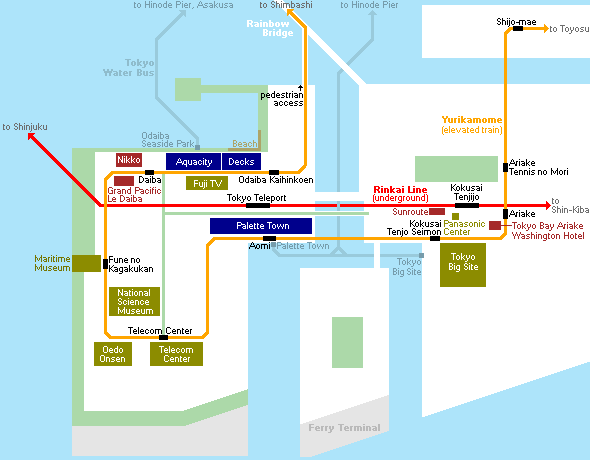

(Map from Japan Guide)

Odaiba is quite large, so taking in all the sights would undoubtedly be a long, exhausting day, even in good weather. My chosen route for the day was as follows:

Shinbashi-- Alighted from the JR Yamanote line and transfered to the yurikamome monorail, which gave me some great views of Tokyo Bay, plus I got to experience the interesting curlyque structure of Rainbow Bridge.

My first stop was Odaiba Kaihinkoen, which is a beach complete with sand, boardwalk, and restaurants. As it is the middle of winter, I had the boardwalk to myself for most of my stroll.

A view of Rainbow Bridge and Central Tokyo.


The beach area at Odaiba Kaihinkoen.


Odaiba Kaihinkoen has a nice boardwalk, which stretches quite far and is ideal for a traffic sounds-free stroll in Tokyo.


This is the Fuji TV headquarters-- the golden ball is an observation deck, and Aqua City Odaiba, a shopping mall. You can take tours of Fuju HQ, but I saw the hoardes of people and the ubitquious staff with plastic megaphones making endless (some being the pointless type unique to Japan) announcements, and steered clear of the self-guided tour option due to a combination of having a low frustration tolerance and the foresight of 4 years' experience dealing with local crowds in public places.


You can see some quite large anchors off the boardwalk, and there is also a Maritime Museum which is supposed to be good for the sea-oriented visitors.


Did I take a wrong turn? Nope, there's a Statue of Liberty at Odaiba too.


The Statue of Liberty, Rainbow Bridge, and Central Tokyo.


Hotel Nikko Odaiba, a seaside accommodation.


This is the great staircase leading up to Fuji TV headquarters.


The Telecom Center. It was refreshing to see buildings in a shape/color other than institutional white/grey.

I strolled to the Venus Fort shopping mall as I heard about the European-looking architecture inside, and sure enough I thought I had accidentally took another wrong turn and ended up at the Villaggio in Doha (but there's no canal in this one).


There's a Church Plaza...


European-looking pathways, complete with painted sky...


And even a Fountain Plaza.

Finally, the Venus Fort is near the Toyota Mega Web, which is a huge PR endeavor on Toyota's part. The Mega Web has a large showroom with the latest domestic car models-- which you can take photographs of and even climb in and out of freely (including the Lexus models, the most expensive being almost Y10 million, or roughly USD$120,000!), car accessories, and future technologies being developed. There is also a test driving track, but you've got to have a Japanese driving license. In a nod to the past, Toyota has its History Garage, a pretty cool car museum with old Japanese and foreign cars, and the Universal Design Showcase to introduce and explain the evolution of automobile universal design features such as gauge location, steering wheel accessory buttons, steering column adjustment/design, back bumper sensors, and internal car sounds (seat belts, turn signals etc.).

Inside the History Garage...


Yep, that's a Delorean.


The model showroom, split by vehicle type (SUV, sedan, compacts etc.)


The Lexus wing, which has its own security staff..


And the Universal Design Showcase.

There are lots of other attractions at Odaiba, including the Oedo Onsen, the National Science Museum, the Future Museum, the Panasonic Center (Panasonic's PR venture, which, from description, sounds quite similar to Sony's center at Ginza), and Tokyo Big Site. Odaiba is definitely a must-see for tourists and residents alike, as the spacious layout lends itself nicely to maintaining one's space and finding some peace in a crowded city (country, for that matter), and tourists can see that not all of Tokyo is drab grey buildings, traffic congestion, and power lines.

Sunday, 6 February 2011

Leaving Japan : 5 Things I Will Miss

As the school / business year ends in Japan, so, too, will my work contract. After long and careful thought, I have decided not to renew, and to move on from Japan to another adventure. Thinking back over my 'returnee' experience, I have to say it's interesting how one's perspective of a place changes over time. When I first arrived in 2003, with no Japanese ability, I was swept away by the experience of living in a non-Western society, with the instantaneous shift from being a cultural majority to a minority presenting a number of settling-in and everyday living issues. However, as I conquered various obstacles, and reveled in being in such an electronically 'advanced' nation. After 3 years, I was tired of the English entertain... teaching gig, but still found it difficult to leave my small community and the life I had discovered.

But after living in the Gulf, where going to another State or even Europe/Asia for business or pleasure are almost routine procedures, I have found myself feeling quite isolated in Japan. Although I live outside one of the largest cities in the world, where one might expect to find extensive internationalization, my experience has been that 'international' travel is quite commonly an organized 5-day package tour junket to Guam, Hawaii, Bali, or China. The 'advanced electronic' society, I have come to realize, is, indeed, advanced-- for internal services. Take mobile telephones, for instance. In Japan, you can choose a mobile phone that has features such as TV reception, high-speed wifi Internet, a multi-megapixel camera, high-def video, and the Hello Kitty wallpaper pack. However, you cannot pick up that same mobile telephone and use it to send a regular SMS text message to a friend living in another country. That is because, get this, mobile phones in Japan have e-mail addresses. Yes, e-mail addresses, such as one you would sign up for at Gmail or Hotmail. Not very realistic.

While living in another country, it is often easy to fall into the trap of focusing on negative or not-so-desirable traits of the local culture/system. Every country, though, has its good and bad points, and ensuring a good experience means remembering the good whilst accepting the bad without trivializing minor points until they become a well-rehearsed mantra.

And so, with approximately 6 weeks left to go until the big metal bird leaves from Narita (or Haneda, or Osaka... I don't know which yet) with me on it, here are 5 things I will miss about living in Japan, and about the Kanto area.

1. The ease of healthy eating

Sure, Japan has its share of Western fast-food chains such as McDonald's, KFC, and Burger King, as well as Japanese-style fast-food chains such as Yoshinoya or Sukiya, but how about cooking at home? When I visit my local supermarket, the 'outer edge' areas-- produce, seafood, fish, dairy, bakery-- are quite large, while the processed and tinned goods are minimal. The produce area is chockers with international vegetable choices such as peppers, lettuce, and fruits, but there are also a lot of local products such as daikon (white radish), renkon (lotus root), gobo (burdock), and bean sprouts. Yes, it's true that Y200 apples and Y800 mangos do exist, as do Y30,000 mushrooms, but a lot of the vegetables are quite cheap and easy to prepare. Indeed, there are a number of staple Japanese dishes which only require vegetables, and *could* have tofu or meat if one chooses to add. My favorite vegetable dish is called chikuzenni. This is a combination of daikon, renkon, carrot, squash (if you want), gobo, konnyaku, and maybe chicken or tofu, simmered in a broth of minimal water, soy sauce, sake, and a tiny bit of sugar.

Indeed, it is incredibly easy and cost-effective to eat healthy here, if one avoids the takeaway shops which are filled with fried foods.

2. Transportation system

Living outside Tokyo, naturally the transportation system is linked rather seamlessly with the city subway system, and can be easily traversed with an electronic fare card. At first, the Tokyo Metro System looks like a nightmare, but becomes much easier as you go.

3. Internal payment/delivery services

Japan has an impressive system for domestic goods delivery. The generic term is takkyubin, which translates as 'home delivery', but is carried out by a couple of major companies-- Kuroneko ("black cat", and the logo is a momma cat carrying a baby cat), and Sagawa. Just about anything can be shipped through takkyubin-- frozen/chilled goods, sports equipment, gifts, documents, luggage-- and rates are dependent on type of good and delivery region. If I am traveling in Japan and will have large luggage such as a dive bag, I can, for instance, go to my local convenience store with the bag (or phone for pickup), fill out a form, and the delivery company will pick up my bag, deliver it to my destination hotel, and then collect the bag for return to my apartment. On request, they will even deliver the bag on a certain day and time (as long as it satisfies the transit time requirement). Because this is a time-conscientious society, if I request, say, Friday evening from 7-9pm, the bag WILL arrive on Friday between 7-9pm baring typhoons or other circumstances beyond anyone's control.
Internal payment. When my electricity/water/gas bills arrive, I simply walk to my nearest convenience store, hand the bill to the cashier, and pay on the spot. I can even use a payment ticket machine to buy sports/event tickets, pay for ANA flights, pay for an Amazon order, or a number of other services. You receive a receipt which goes to the cashier, who takes the cash, scans, stamps, and it's done. There is no worrying whether the payment will be received on time or not-- it WILL.

4. Places to see, things to do: from the snow to the sea

Okay, high cost of traveling in Japan aside, I live in decent proximity to a lot of Honshu. The Japan Alps, which boast some fantastic winter sports opportunities, are only an hour to an hour and a half away by Shinkansen. I was looking forward to experiencing a lot more of the Japan Alps this year, but unfortunately tearing my ACL ended my skiing for the season.
On the other hand, there are a number of great islands south of Tokyo in the Izu-Chain. Last summer, during diving season, I got to go to two : Oshima and Shikinejima. The fall is a good time to travel as the humidity has gone away, but I got sick right during prime time so was unable to dive.

5. Reduce, Reuse, Recycle

Japan is made up of relatively crowded islands, and there simply isn't room for the landfills found in other countries such as the US. The answer-- recycling. In Japan, it seems that everything possible is recycled, from cans to newspapers to broken electronics. Unlike other countries, though, where environmentally-conscience people have to make a great effort to recycle, the act has become part of everyday life. Bins in public areas are often separated, such as these, and, yes, people DO separate their trash appropriately. Even home rubbish collection is recycle-based, where calendars and charts are circulated by the individual municipalities advertising the days and methods for putting out burnable trash, non-burnable trash (broken umbrellas etc.), cans, PET bottles, 'dangerous' trash (broken glasses, aerosol cans, razor blades, old kitchen knives smaller than 50cm etc.), old clothing, and newspaper/boxes. The disposal trucks pick up these items, and the fees are paid with your regular water/sewage. Large items such as TVs, bicycles, furniture are collected for a fee either by the municipality (you call and reserve, then get a ticket from the convenience store) or by recycling trucks-- private people who collect your items, charge you a nominal fee, then make a bit more when they sell to the recycling plant. Milk/juice cartons and white meat trays can be washed and put in dedicated bins at supermarkets.

I stayed for 2 years in Qatar, where copious amounts of bottled water and soda are consumed but there is no system for recycling. Having lived in Japan for 3 years prior to that, I felt incredibly self-conscientious and wasteful tossing these items dismissively in with the regular trash. With Qatar hosting the 2022 World Cup, and thinking of the amount of trash that will be generated in such a small country, I hope that for the country's sake, and in considering the environment, that there are plans to build a recycling plant and to start taking care of these items.

Saturday, 13 November 2010

Sanno Hospital and an ode to living

First and foremost, I want to give a thousand praises to the staff at Sanno Hospital in Tokyo, where I have now visited for two separate medical cases and received superior medical care. With this being my 4th year of residence in Japan, regular conversation and day-to-day tasks present very few communication barriers thanks to a LOT of independent study and continual effort. However, being sick or injured is a stressful experience in itself, and trying to communicate one's medical issues in a foreign language or understand specialized medical language can be daunting at the best of times. An acquaintance recommended Sanno Hospital, as her company has a lot of expatriate workers and this is where they are recommended to visit for their health care requirements because the hospital takes national health insurance and there are a number of English-speaking staff. From the moment I walked in the door, I was introduced to the Ritz Carlton of hospitals, and will no doubt find it difficult to go to a "regular" hospital again. (^^)

As an update to my life, I've been very sick once, last fall, and I was injured while skiing last month. Here are the gory details:

In late October I developed a severe lymph node infection in my neck, and my lymph node became red and swelled almost to the size of a golf ball. I went to a local clinic to see an internal medicine doctor, who proceeded to speak to me in rapid and difficult Japanese. He started using words such as 'cancer' (without having even taken a blood sample!) and 'hospital stay' without having even given a physical examination. Needless to say, I was very put off and required a bit more TLC in a second opinion.

As soon as I walked in the door that Saturday morning, I wondered if I had wandered into a hotel lobby-- the decor includes stuffed chairs (even in the waiting areas!), soft lighting, a grand piano, and numerous plants. No loudspeaker announcements or people running about madly. When I filled out my registration form and handed it in, the head nurse on duty saw my neck and wasn't sure if I shouldn't instead go to the dermatologist. She came to speak to me, bringing a very polite interpreter along so that we could all understand one another-- although I could understand her Japanese with no problems as she spoke TO me without being patronizing or using a lot of medical terminology. As dermatology requires appointments on Saturdays, she immediately made me an appointment to be attended after I had seen the internal medicine doctor.

The internal medicine doctor, as it turns out, lived in Wisconsin, in the US, for 15 years. In fact, she had travelled throughout the US and had a homestay family near where I grew up. She agreed with the head nurse's assessment that I would need to go to dermatology because, as she said, dermatology deals more with the neck area and there are a lot of important things there. I was sent for lab work and a CT scan to determine what the mass was made of, and then on to dermatology.

As it turns out, I had a white blood count of 7.3. Normal is 1-4, and had I been at 10 I would have been immediately hospitalized as that indicates a raging infection. The dermatologist assessed the CT scan, and before her 2 other doctors had assessed the scan and they all agreed that the lump could be drained and exactly where the cut could be made. The dermatologist echoed my other doctor's observation that "the neck has a lot of important things", so I didn't mind that they were being cautious and thorough in their work.

Draining was a minor surgical procedure for which I received local anaesthetic, but I've never experienced pain that intense in my life. The draining involved pressing on the incision to catch the fluids which had built up, and with the first pressing I could actually **hear** the wound draining. I have to say the dermatologist and the nurse were quite shocked, as was I when she showed me the first set of gauze used. 6 times she pressed, and after the 3rd time I was hoping the floor would open up and swallow me whole. I literally shook for 10 minutes after she had finished from shock. I was cleaned and dressed, given antibiotics, and instructed to visit again on Monday for follow-up care.

Monday brought a second surgical incision and more draining (which only hurt a little bit), along with IV antibiotics and having my wound packed with gauze. Because the wound hadn't been packed on Saturday, more infection had gathered. However, she hadn't wanted to pack on Saturday as the dressing needed daily changing and it would be almost 48 hours. Thus, I ended up going every day that entire week for cleaning care and IV antibiotics. But the drugs worked, finally, and a follow-up blood test revealed my white blood count had gone back to normal. I was released for at-home care to my incisions (cleaning and dressing)

Still, though, it took around 2 more weeks for the incision to heal enough that it didn't require covering. Which was a good thing, as I also developed contact dermatitis from the tape and gauze and had to deal with not scratching. In fact, I wondered if I shouldn't wear one of those lampshades they put on dogs at the vet to prevent them from scratching their faces when they've got facial lacerations etc.

I've got a bit of scarring on my neck, and there is some redness present still. But I'm cancer-free, and infection-free, and I can live with the scarring no problem.

So on to the exciting part-- my dramatic skiing accident.

I went skiing last month at Hakuba, where some of the Winter Olympic events were held in 1998. I was getting ready to turn, to bring my speed down, when somehow I caught my left ski. My leg was immobilized whilst my body continued to hurl forward. My leg straightened, then there was a big 'pop' in my left knee, followed by a dramatic somersaulting finish. When the 'pop' happened, I thought to myself, 'oh lordy, here we go...', as I flew through the air. I landed with my left ski vertical in the air (my boot hadn't popped out of the ski, which is kind of interesting actually), right ski strewn beneath me. I lay on my back and waited for the severe pain to start, which, thankfully, didn't. Apparently my crash was dramatic enough that another foreigner skiing stopped to ask if I was all right, and could I get up or did I need assistance. He was kind enough to side step up the mountain to retrieve my poles so I could use them to get up.

Having done research on knee injuries, I realized that a 'pop' often meant a torn ligament, but, miraculously, I had no pain and could put weight on my leg. Turning was out of the question, so I slid my way down to the rest house, around 50 meters down the hill. I took off my skis and went inside, and just sat for a bit with a bowl of ramen (it was around 1pm and I was about to stop for lunch anyway) and a coffee to warm up. There was a beginners run which led to the base, so I took my time and got myself down to the base and on the shuttle bus back to my accommodation.

I knew I needed a doctor, even though I could gimp along. I've sprained my knee before, but this was much different. I made it home from Nagano on a Monday, and returned to Sanno Hospital on Wednesday morning to see an orthopedics doctor. She was in immediate agreement that ACL damage was a highly suspect result of the 'pop', and sent me to x-ray to confirm that I hadn't broken any bones. Everything was intact, so I was scheduled for an MRI on Saturday afternoon-- there is only 1 machine, and I wasn't a priority case, so this was literally the first open time slot available.

The MRI was an interesting experience. I had to remove all the metal objects from my body-- even a forgotten bobby pin can break this expensive, expensive machine-- and lay absolutely still for 30 minutes, or the image would be damaged and they would have to redo some or all of the work. Even with the headphones on, I could hear the various noises of the machine as it did its work. Image processing took 2-3 days (again, I wasn't a priority case so join the queue no problem), and I was back the next Wednesday for the result.

The image was really, really cool! It's a 3D picture that the doctor can turn left, right, up, down... she had a knee model and explained what I was seeing on the screen.

Sure enough, I have a torn ACL. Unlike other parts of the body, ACLs can't repair themselves, nor can they be repaired in most cases even with the advancement of medicine, so fixing the problem completely requires reconstructive surgery.

However, the doctor is not definitely recommending surgery in my case. I had a knee injury in high school which was diagnosed as a sprain, but no images were taken. So she isn't sure if all the damage is new, or if I have been functioning with some damage for over 10 years. There is no way to tell new damage from old from the MRI, or any other procedure (yes, I did ask but already suspected this). Also, right now, a major problem is that the muscles around my knee are stiff and weak. ACL reconstruction surgery rehabilitation is a long and tedious process, and definitely not for the weak at heart. So, at this point, to have surgery would mean that trying to complete the rehab with weakened muscles would complicate matters further. So I have been given at-home rehabilitation to do, and I also have a knee brace which I am wearing for support. Thus far the rehabilitation seems to be doing some good. Even after the first day I noticed a definite improvement in my walking, and I most certainly wasn't as stiff. However, if I start experiencing pain, or another bad pop, or have instability, then surgery becomes more of a requirement.

I'm quite lucky. I haven't had a lot of pain, and I do have to be careful not to overdo physical activity. I am slowly improving, and I know that recovery will take time. Staying positive is important in any illness or injury, and I am thankful that my accident wasn't worse. I could have easily broken my leg, requiring pins and plates, or landed wrong and ended up sitting for the rest of my life. I am walking, and will no doubt eventually regain more and more functionality. This may mean that I can't take part in contact sports such as rugby, but then again I hadn't joined the rugby squad before I got hurt and was getting on okay, so I can continue to do so. I am not sure if I can take part in kendo again due to the force placed on the left leg, and chances are arts such as judo or karate are out, but there are other things I CAN do. Bicycling is good as it isn't placing weight on my leg, and surely swimming will also be good, as will diving.

My friend once pointed out that mountain climbers and hikers have a saying, "The mountain will be there tomorrow. The question is, will you?" I sincerely hope to ski again someday, but I know that this season is over because the chances of reinjury are just too high still. On the other hand, since skiing is a high impact sport on knees, if this means that my days on the slopes are done, then I will accept this truth and get on with things. Meanwhile, though, I can count my blessings and prepare for the next adventure in my life : a working holiday in Australia. But more on that later!

Sunday, 31 October 2010

Otona Halloween 2010


I love my local supermarket. When I lived in Oita, I shopped at a place called Marushoku (written 'Sunlife' in English). Here, I've got a supermarket called 'Life' around the corner.

They've had a display of Suntory Malt beer up all summer, where you can buy 3-tin sets which include a free glass. As Halloween has creeped around, the box design changed to a pumpkin motif called 'Otona (adult) Halloween'. This has been a Suntory promotion, and included the regular 350mL tins as well as the 500mL.

Today I pitched up to the supermarket to get a couple tins of beer to have with my curry pie from Jerry's Pies, figuring I would get Sapporo, or maybe even one of the sets. I was in the beer aisle, and I looked to see if there were any 350mL sets, and there weren't. I didn't want 500mL tins, so no problem-- I wandered further down the aisle. Just then, though, a supermarket employee saw me and came right over-- VERY unusual for Japan. The conversation went something like this, in Japanese:

Supermarket Employee (SE): Oh, are you looking for the regular size sets?
Me : Well, yes, I had been, but I see they're sold out. No problem.
SE : Shall I look in the back for more?
Me : Oh, no no, please don't go to that trouble. It's no problem.
SE : Really? Are you sure?
Me : Oh yes. I came yesterday, and there were sets, but I didn't buy one, so it's really my fault.
SE : Oh, no, it's not that at all. Yes, but it's really a great set with the glass and all.
Me : Yes, it is, so I'm sure they've been quite popular.
SE : Yes, they have. I'll go look and see if we have more. Are you in a hurry?
Me : Oh, you really don't have to do that. I don't mind buying something else.
SE : Are you sure?
Me : Oh, yes, it's no problem.)
SE : No no, I'll go look! If we don't have one made, we may be able to change one of the big tin sets for you.
Me : Oh, that's a lot of trouble. Please don't worry.
SE : No no, I'll go look. Wait a minute.

Before I could say anything, she RAN off. I, feeling a bit embarrassed by the trouble she was taking, sheepishly hung around the beer aisle as it would have been completely rude to walk off. Not 3 minutes later, she comes running back.

SE : I'm so sorry to have kept you waiting!
Me : Oh, no no, it was no bother at all. I'm so sorry to put you through all this trouble.
SE : We don't have any more sets, but we can change out one of the big set for you.
Me : Are you sure? I don't want to put you to any trouble.
SE : Oh no no, it's no trouble at all. These are a Halloween promotion, so we want to use the boxes by today anyway. What would you like? 3 tins of regular?
Me : (by now absolutely impressed by all of this) Oh... well, sure, yes please.
SE : (Walking over to the display). Oh... well, this tag says Y638 for 3, but the actual beer price is a bit higher. Is that okay?
Me : (at this point I'm not going to say no!) Yes, no problem at all.
SE : Oh, but this sign is a promotion for 2 regular beers and 1 dark ale... but how much is the dark ale.. let's see...
(she walks over to the individual regular tins)...
So the regular tins are Y215, so 3 would be Y645 (she had a calculator in her pocket), but how much is the dark ale...
Me : Oh, it's Y245
SE : Oh right... well, 2 tins of regular and 1 of dark... (calculates) but with a set discount (more calculations)... the price would be Y672. Is that okay?
Me : Sure, no problem at all (She had taken so much trouble at this point that I would have paid the regular price without a peep of complaint). Are you sure this is okay? I don't mind paying the full price
SE : Oh, no, we're happy to do this. It's a great promotion with the free glass, and we want to get rid of the Halloween promotion boxes, and we see you often in the supermarket anyway (VERY impressive to be remembered in suburban Tokyo!) so think of it as a small token of gratitude.
Me : Yes, this is is my local supermarket, as I just live around the corner, so I shop here at least once a week. This is incredibly nice of you... thank you so much for taking the trouble.
SE : Oh, it was no trouble at all. Happy Halloween, and enjoy!

Saturday, 7 August 2010

Memory Lane Soundtrack

Whilst packing for my latest adventure, a return to muck diving at Lembeh, Indonesia, my iPod queued up Earth, Wind and Fire's classic song September. My Southeast Asian journey started almost exactly 6 years ago (August 2004) in Singapore and continued through Peninsular Malaysia, with stops in Melaka, Kuala Lumpur, and Georgetown. I remember the amazement of seeing the ubiquitous Southeast Asian landscape slip by whilst listening to this song, as well as another funk classic, Chicago's 25 or 6 to 4.

I still find it hard to believe at times that I'm still kicking around the region.

Enjoy!


Saturday, 1 May 2010

Yebisu Beer Museum


Yesterday, during my Golden Week holiday, I visited the Yebisu Beer Museum at Ebisu, in Tokyo. Yebisu Beer is a famous beer produced by Sapporo, and just celebrated its 120th birthday in 2007. Ebisu is the modern day spelling of Yebisu. There used to be a Ye character, but it has disappeared from contemporary Japanese.

The Yebisu Beer Museum is quite easy to find as part of Ebisu Garden Place from Ebisu Station, via the JR Yamanote or Hibiya subway line. The Ebisu Garden Place is clearly marked from the JR station, and there is even a convenient set of travellators provided to whisk patrons more comfortably and quickly to their various Garden Place pursuits. Ebisu Garden Place used to be a brewery, but today is home to other shops including a Mitsukoshi department store, a Sapporo Beer Station, and a Michelin 3-star French restaurant. Sapporo does maintain business offices here too, though.

The museum itself is most easily found by walking through Mitsukoshi. Admission to the museum is free, although there is an option for a 500 yen tour. This takes 40 minutes, and includes a 10-15 'communication' session where you taste 2 or 3 glasses of beer. All of the tours are in Japanese.


I find the old labeling and advertising quite interesting.


The final stop is a tasting salon, where 4 different kinds of Yebisu are on tap and can be purchased for Y400 a glass. (For those who know Japan, this is a bargain). In looking at the tour, though, it may be worthwhile for non-Japanese speakers to become conveniently fluent, as the 500 yen tour glasses were the same size and contained the same amount of beer as those being served in the tasting salon for 400 yen each.


Tuesday, 20 April 2010

Back to Japan

So I've done what I never thought I would do, and that is I've taken an English teaching job in Japan. Hey, a job is a job. I'm in a private school this time, though, and the pace is much, much different. We've got class sizes of 8 maximum, and they only come for 1 hour each week. It's a lot of planning and work, but definitely a challenge.

I'm living in Saitama, just 25km from downtown Tokyo. It is a breath of fresh air from being in Oita. Train services are convenient, as I'm only 500m from the station, and I have a supermarket, pharmacy, 2 Indian restaurants, a Thai restaurant, and an Indonesian restaurant within a 800 m radius of my apartment.

I look forward to sharing tidbits about life in Japan in the next year!

Wednesday, 17 February 2010

Small Change

One thing people from developed countries may take for granted in their daily lives is the continual availability and abundance of cash. This is not an economic statement, but rather one of practical concern: in a developing country, due to the frequent shortage of smaller-denomination banknotes, a "rich" tourist or expatriate may actually not be able to spend their money simply because all they have are large denomination notes and the shop does not have the change to give back!

Some countries such as Vietnam and Cambodia operate on a multiple currency system, where larger purchases and payments are made with US dollars or Thailand Baht but change is given in Dong (Vietnam) or Riel (Cambodia); in these cases the exchange rate is usually consistent from shop to shop and based on a rounded average. Multiple currency countries are in existence because the local currency is not very strong due to sudden revaluation on the whim of the leadership (as was the case in Zimbabwe) or a weak economic platform. Thus, the currency of a stable economy (usually the US dollar) is used in conjunction with the local currency because it will not devalue suddenly, and can often be traded legally or on the black market by shopkeepers.

The Philippines, though, is one example of a developing country where spending one's money can actually be a problem. The Philippines is a single-currency nation which prints its money, the Philippine Peso, in a wide range of banknotes and coins. In the rural parts of the Philippines (the provinces), costs are low and require small banknotes or coins. Shopkeepers, then, keep small amounts of small change on hand, and an even more limited supply of larger notes-- which, naturally, they are reluctant to part with. Cash machines and currency exchanges only dispense currency in large denominations, so a tourist fresh off the airplane will have a pocketful of money that, when attempting to purchase goods in a shop, will be met with complaint because the shopkeepers will have to either part with their change or send someone to scramble for smaller notes. Reluctance may not seem like the best form of customer service, but in an area where the average laborer's wage is PHP200 (roughly USD$4.50) a day, with bar and restaurant staff earning PHP1,000 to 2,000 a week if they are lucky, the overall goal is to do as little as possible. Especially in a tropical country where the sun is still hot, even in the winter.

To counter this problem, I tend to hoard small notes, and use slightly larger notes as often as possible in establishments where I know they can be changed. This I do even if I, indeed, have a smaller note in my wallet. The keys to this practice, though, are to use a larger note, but nothing too large, and to also know which shops will have an abundance of change. For instance, if I make a purchase of 40 peso at the local supermarket, I will give a 100 peso note so I can keep the small change (a 50 peso note and a 10 peso coin) I receive back. On my once-weekly visit to a restaurant for dinner, which is usually part of a resort that will definitely have cash on hand to deal with the large-denomination holding tourists and street-smart expats, I take my PHP500 or 1,000 notes in order to get the 100 peso notes back that I can use at the supermarket or pub.

So where do the smaller notes, such as the 20 and 50 notes, and change go? I use these at smaller places such as the water refilling station or the fruit/vegetable stands, or with the jeepney drivers when I go once a week to Puerto Galera for food shopping. I do occasionally have to make a very small purchase at the supermarket, and I'll use a small note then.

The best advice I can offer to people who are going to travel in the Philippines or other developing countries, then, is to plan ahead money-wise. Spend a day or two in a city first, use large bills for every single purchase, and hoard the small change. You may end up with a gym bag* full of cash, but it will be needed in the provinces when it comes time to pay for food, transportation and accommodation.

*During my visit to Vietnam in April 2005, I started off in Hanoi. At the time, the Dong to US dollar exchange rate was roughly VHD16,000/USD$1. This isn't groundbreaking news in itself, but a majority of the currency on the street comes in VHD1,000 and 5,000 banknotes, with an occasional 10,000 note, meaning a loaf of bread requires a small bundle of banknotes to purchase. On my first day, I went to a expat-owned local pub for pizza and beer. The owner came in with a black Adidas gym bag, which he set on the counter behind the bar and then motioned to the nearby Vietnamese bartender. Sitting at the bar, I watched him furtively open the bag to reveal, well, a Mafia-style bag of cash, which he then zipped shut and stored in a locked cabinet under the bar. Later, during a conversation with the owner regarding the local currency and costs, etc., he told me that banking is a twice a week activity due to the cash movement, and it was not unusual to have more than one bag of cash ready in a safe for a weekend rush or over holidays.

Thursday, 4 February 2010

Catch Up

So I've not blogged for a while, partially because I've been busy, but also because I've not been in a place where I could sit down and really do so.

For starters, I'm no longer in the country beginning with Q. I was meant to go to the Philippines to take my PADI Instructor Development Course (IDC) in mid-November, and two weeks prior to my departure I found out that I would have to leave Qatar since I would no longer have a job or a sponsor. I still went to the Philippines for my course, and at the end of the course I decided to sit the Instructor's Exam (IE) and I passed. So I am now a PADI Open Water Scuba Instructor (OWSI).

I'm still stuck in the Philippines, as it is easier to stay in one place and look for a job. I am pursuing jobs on several fronts:
1. Another job in Qatar or even the Gulf, either in my profession or in whatever I could be hired to do;
2. Teaching English in Japan, Korea, or Taiwan;
3. Being invited to apply for a permanent visa in New Zealand;
4. Looking for a diving instructor job whilst trying to get into something more permanent.

It's not so bad being away from the library, actually. The last job I had really took its toll on me physically. With being in front of a computer 8+ hours a day, 5 days a week, for 2 years and 1 month, my vision has deteriorated to the point where I have astigmatism in both eyes now. I have to wear toric contact lenses, which are a pain in the you-know-where, but at least I can still see. I have chronic headaches and suffer from severe neck and shoulder pain, all of which come and go. A few weeks ago, though, I slept wrong and was in agony for almost an entire week. Stress also triggers the pains, making tough going even tougher. Regular painkillers don't help, either. A drug called Flanax, which targets musculoskeletal pain, was recommended to me here, and the few times I've had to use it have brought relief. I wish I would have known about this sooner! I'd like to see if I could get some sort of alternative therapy (rolfing, reiki, acupuncture or the like) to cure this.

I miss Qatar a lot, and was quite happy there. However, I had already known it was time to look for another job. I had been getting my CV together, and getting it updated and critiqued, and had been looking at employment ads for jobs in Qatar/the Gulf and even for teaching in Japan again. It would have been nice to have left on my own terms, but so it goes. If I hadn't gotten the push out the door, I may still be there thinking I should leave. The grass is always greener, I suppose.

Being in the position of looking for a job, though, I am thinking about going back to uni in either Australia or New Zealand. This is partially so I can perhaps get a more useful qualification (in hindsight, I've got one of the most useless and misperceived qualifications of them all; prospective employers assume you can only work in a library even if you describe your field and skills as Information Organization and Retrieval; Information Optimization etc., and correcting perceptions is next to impossible), but also so I can get more points on a visa application. Plus if I can enter either country on a student visa, this may lead to internships, which could lead to jobs or good recommendations for other jobs. I don't know what I'm interested in yet-- I'm not good at maths, so useful professions such as engineering or business are right out. I started out in Computer Science in uni years ago, but programming is not my forte either. I am thinking about something in communications, actually. I enjoy writing, and I got to do a bit of layout in my last job, which was a lot of fun minus all the political mumbo jumbo and Hail Mary cranky last-minute scramble efforts which were endemic in my last workplace.

I do enjoy teaching, and I've missed being in the classroom. While instruction is a core component of being a librarian, the instructional opportunities were few and far between, and the rare occasions usually tainted by the atmosphere. There were exceptions, of course. So one never knows-- if I am given the chance to teach, I may find this is my calling, and I may pursue a qualification in this profession.

I am also considering a working holiday visa in Australia or New Zealand. I can go for up to 1 year, and this could lead into something more permanent.

"Stuck" here is not an overstatement, either. I'm not fond of where I am, but I know it is only temporary (and I am trying to make it as temporary as possible) and then I don't have to come back. I don't dive at all here, as it is very expensive and quite frankly the last dive I was on here I was so unimpressed that I said no more. I spend my days reading what I can find, which isn't much. I also watch TV, go on walks, and job hunt. A lot. We recently got Internet at the place where I am staying, so this is a blessing as I can stay home to do my work and don't have to be limited to my computer battery time or spend money each time to go online. I also discovered that my Chinese DVD player has a VCD with old-school Nintendo games and game controllers, so I've been busy exploring and rediscovering games from my childhood.